

April 1st: The Real New Year They Tried to Erase – And Why They Called Us Fools for Remembering
Posted in: Deception · Holidays · Hidden Truth
Date: 2026-4-1 15:38:28
DISCLAIMER: This article presents an alternative perspective on the origins of April Fool's Day. This view differs from the commonly accepted historical explanation involving 16th-century calendar reforms in Europe. Reader discretion is advised
Today Feels Different for a Reason
Deep down, the body recognizes the change. The sun rises higher each day, the earth awakens from its long sleep, flowers push through the soil, and life begins its cycle of renewal. This sense of fresh beginning belongs to April, not to January in the depths of winter.
For centuries, our ancestors observed April 1st as the true start of the New Year. It aligned with the natural seasons and the order of creation. When authorities changed the calendar, those who held to the older tradition became the object of mockery. This is the real origin of April Fool’s Day — a quiet reminder of how ordinary people were ridiculed for remembering nature’s own reset.
Before the Calendar Change
In medieval Europe, particularly in France and among communities tied closely to the land, the New Year was celebrated around the spring equinox. The timing made practical sense. Winter had ended, the ground had thawed, livestock gave birth, and farmers prepared for planting.
Festivities often extended from late March into the first days of April. April 1st served as the symbolic kickoff to the fresh year. These observances honored seasonal rebirth through simple communal gatherings rather than an imposed midwinter date.
The Calendar Shift
In 1564, King Charles IX of France issued the Edict of Roussillon, officially moving the start of the year to January 1. The change was later reinforced by the adoption of the Gregorian calendar in 1582. Although presented as a matter of accuracy and standardization, the reform disrupted long-established customs.
News traveled slowly in that era. Many rural communities continued to mark the New Year in late March or early April, following the practices passed down through generations.
The Birth of April Fool’s Day
Those who adopted the new January date began to mock those who maintained the older observance. They sent fake invitations to New Year events that no longer existed under the revised calendar. They delivered meaningless gifts and played tricks on the holdouts. These individuals were labeled “April fools” for their loyalty to the traditional date.
The practice of such pranks spread and evolved into the annual tradition of lighthearted hoaxes on April 1st. The very name April Fool’s Day carries the echo of that original ridicule directed at the common folk.
A Perspective Rooted in Nature
The people called fools were simply following the clear rhythms of the seasons, the land, and the cycle of renewal. They chose the awakening of spring over a cold January administrative reset. The name of the day itself reveals the central idea: holding to the New Year that matched creation made one the target of laughter.
What started as mockery of traditionalists became a yearly custom that continues to this day.
Relevance Today
Similar patterns remain visible in our time. Systems change rules and dates, then treat those who remember older, more intuitive ways as outdated. April 1st keeps that memory alive through its jokes and pranks.
When someone calls out “April Fool!” after a trick, it quietly recalls the time when adherence to seasonal truth became the punchline.
What They Actually Did to Celebrate the Real New Year Back Then
Before the calendar reform, ordinary people observed the New Year around March 25, the Feast of the Annunciation, also known as Lady Day. Celebrations frequently extended into early April, including April 1st. These were modest, community-centered events grounded in faith and the land.
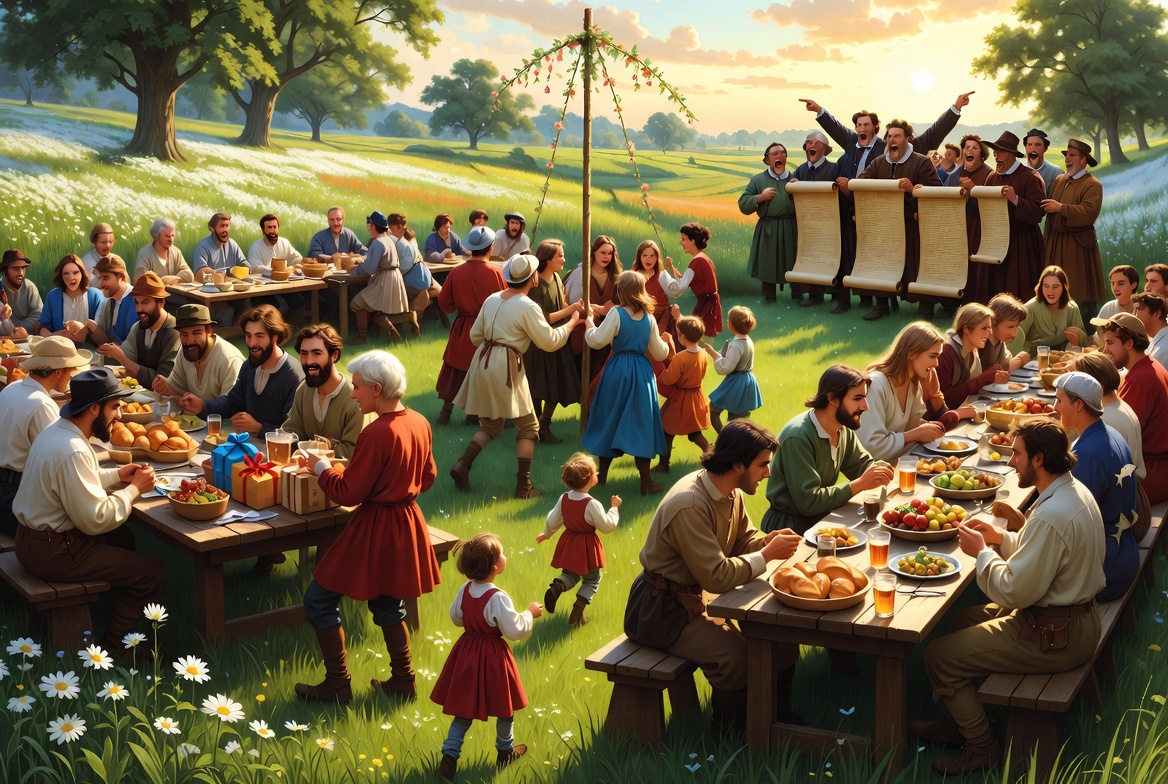
Families and neighbors gathered for communal feasts featuring bread, ale, preserved meats or fish, early spring greens, and fruits saved from storage. As winter supplies dwindled, the first signs of new growth brought hope and relief.
People exchanged simple, practical gifts such as tools, woven cloth, or small amounts of honey to mark the fresh start and express goodwill. Music filled the air, along with dancing in fields or village squares and processions that celebrated the thawing ground and blooming flowers. Children played freely while adults shared stories.
The celebration combined religious observance of the announcement to Mary with a strong emphasis on tangible renewal: the beginning of the planting season, the birth of young animals, and the end of winter’s hardships. Those who continued these practices after the official shift to January 1st were mocked as “April fools.” Their treatment gave rise to the prank tradition that defines April Fool’s Day today.
Reflection on This Day
On April 1st, it is worth remembering the generations who faced ridicule for honoring the arrival of spring. The modern calendar places the New Year in January, yet the turning of the seasons points elsewhere. Dates on paper can be rewritten, but the cycles of nature remain unchanged.
Happy Real New Year
First off, I really mean that and I am not posting this in celebration of April Fool's, I'm not doing it to trick you, and this is not a joke, so don't even try to go around saying that at all, because it's just not true. But, with that said: May this April 1st serve as a quiet acknowledgment of the deeper rhythms that guided our peoples for centuries. And you know what? Who's really the "fool" for celebrating "April Fool's Day" instead of an actual week long holiday that celebrates God's creation of this world and the yearly seasons? Be honest… only a fool would trade a whole week of celebrations for just one measly ole corny joke of a holiday.