
Beneath the Surface: The Hidden Narrative of Underground Worlds, Forbidden Maps, and Unseen Predators
Posted in: Conspiracy · Underground Civilizations · Secret History
Date: 2026-3-26 02:01:53
STRONG DISCLAIMER:
This article presents a collection of claims, interpretations, and narratives that explore unconventional perspectives on hidden civilizations, non-human entities, and alternative understandings of Earth’s structure. The content is intended for speculative, entertainment, and thought-provoking purposes only.
Many of the ideas discussed are not supported by verified scientific evidence or mainstream historical consensus. Readers are encouraged to approach the material with critical thinking and to distinguish between documented facts, personal testimonies, and interpretive theories.
The themes included may be unsettling or intense for some audiences, particularly those involving missing persons or predatory behavior. Viewer discretion is advised.
This piece does not claim to present confirmed reality, but rather examines a narrative that exists within fringe discussions and alternative research communities.
The Claims That Challenge Reality
For decades, the public has been told that the world is mapped, understood, and largely accounted for. The unknown, we are taught, exists in distant galaxies or at the edge of scientific discovery. But there is another narrative—one that does not look to the stars, but instead turns its attention downward, into the depths beneath our feet.
According to a series of controversial accounts attributed to alleged insiders and whistleblowers, the greatest secret may not be what lies beyond Earth, but what has always existed within it. These claims describe a hidden reality of subterranean civilizations, non-human entities, and ancient pathways concealed beneath layers of secrecy and disbelief.
The Allegations and the Voice Behind Them
Another dimension of this narrative does not look to distant galaxies for the origin of non-human beings, but instead turns to ancient texts such as the Book of Enoch. In these writings, the world is described as enclosed within a firmament—a structured boundary separating different realms of existence. Within this interpretation, what is considered “otherworldly” may not be distant at all, but part of a layered system existing alongside humanity.
This perspective is used to support a broader claim: that non-human intelligences are not visitors from deep space, but long-term inhabitants of adjacent domains within Earth’s structure. Their presence, in this view, is not recent, but ancient—predating modern civilization and continuing alongside it.
Many of the claims explored in this narrative can be traced back to a figure frequently referenced in discussions surrounding non-human intelligence and hidden histories: Alex Collier. Emerging in the early 1990s, Collier presented himself not as a traditional whistleblower, but as a contactee—someone claiming direct, ongoing communication with non-human beings identified as Greys and Andromedans.
Alex Collier claims his contact with the Andromedans began when he was 8 years old and has been an ongoing, 20-year mentorship with two beings named Vissaeus and Morenae from the Andromeda galaxy. The contacts are both telepathic and physical.
The physical meetings occurred at various locations, often where he was instructed to go, and the Andromedans would arrive in craft. One notable witnessed event happened in Malibu, California, in what he believes was 1985, during a meditation with a group. A UFO was seen by 22-23 people as stars in the foggy sky formed a circle, then a line, and responded to a request by performing a "lazy figure eight" before disappearing.
He has also been taken aboard their massive mothership, described as 800 to 900 miles wide, where time is distorted (e.g., three months aboard equaled 18 minutes on Earth). The Andromedans, whom he refers to as the Zenetae, have been observing Earth for hundreds of thousands of years.
Within the testimony associated with this narrative, these ideas are taken further. The speaker describes not only the existence of such beings, but an ongoing relationship between them and human institutions. This relationship is characterized as controlled, concealed, and transactional.
According to the claim, a dark agreement exists between certain human authorities and non-human entities. The terms of this alleged arrangement are described in stark terms: that these beings remain largely out of public sight, while in return, access to human populations for them to feed on is permitted under conditions that are not disclosed to the public. In the clip, Alex claims that humans made a deal with Draconians and the Greys that they take live children underground to the Greys for them to take to the Draconians for the consumption of living humans.
In this framing, disappearances are not random events but are interpreted as part of that hidden exchange. The claim suggests that what appears unexplained on the surface may be connected to systems operating outside public visibility, sustained by secrecy and protected by those aware of it. The implication is not only the existence of non-human life, but the possibility of cooperation or compromise at levels of power that remain inaccessible to the general population.
This transforms the narrative from one of unknown entities to one of alleged corruption—where knowledge, authority, and silence intersect.
A Presence Beneath Humanity
At the center of this narrative is the claim that a non-human species, often referred to as Alpha Draconians, resides deep underground, between one hundred and two hundred miles beneath the Earth’s surface. These beings are described as long-lived, with lifespans stretching thousands of years, and fundamentally different from humanity in both biology and behavior.
They are not portrayed as passive or distant. Instead, they are described as carnivorous and hostile, existing within a system that intersects with human life in disturbing ways. One of the most unsettling aspects of these claims is the assertion that their consumption requires living prey at the moment of death, suggesting a process that is not only physical but tied to something less easily explained.
Andromedans and Draconians are not the same thing; they are described as opposing galactic factions with fundamentally different philosophies. According to Andromedan contactee Alex Collier, the Andromedans are a distinct race who view the Draconians as the "ultimate warriors" in a negative sense and consider them "bullies" who operate on fear and control.
The Draconians (specifically the Alpha Draconians) are characterized as the oldest reptilian race in the universe, originating from the Alpha Draconis system, who believe they were "dumped" there to rule and view life as a natural resource to be genetically altered and exploited. In contrast, the Andromedans are portrayed as respecting free expression and opposing the Draconian hierarchy, which is led by races that instill fear-based belief systems and seek to dominate other civilizations.
Origins: The Andromedans do not know where the Draconians came from, only that they were placed in the Alpha Draconis system.
Philosophy: Draconians follow a "Service-to-Self" mindset, believing humans are at fault for invading the universe, while Andromedans align with principles of free will and evolution.
History: They have been engaged in a "Great Galactic War" where Draconians destroyed planets in the Lyran system, killing millions of early humans, establishing an ancient struggle between the two groups.
The World Beneath the World
These claims begin to expand when placed alongside the concept of a vast subterranean civilization known as Agartha. Described in ancient traditions and recurring in modern fringe discussions, Agartha is said to be an enormous inner world containing entire ecosystems, cities, and advanced forms of life.
Rather than existing as a myth, it is portrayed as an infrastructure—a network that has existed far longer than recorded history. In this framework, underground facilities commonly associated with secrecy are not isolated installations, but access points. Beneath them, it is suggested, lie passageways and environments that connect to something far older and far larger than modern civilization.
The idea is not simply that something exists underground, but that it has always been there, operating independently or in parallel with the surface world. The secrecy surrounding certain locations is therefore interpreted not as protection of technology alone, but as a means of concealing access.
This convergence of ancient lore and modern secrecy forms a central tension in the narrative. Stories once dismissed as legend begin to mirror claims emerging from contemporary sources, creating a sense that fragments of the same truth may be appearing across time.
Maps to the Forbidden
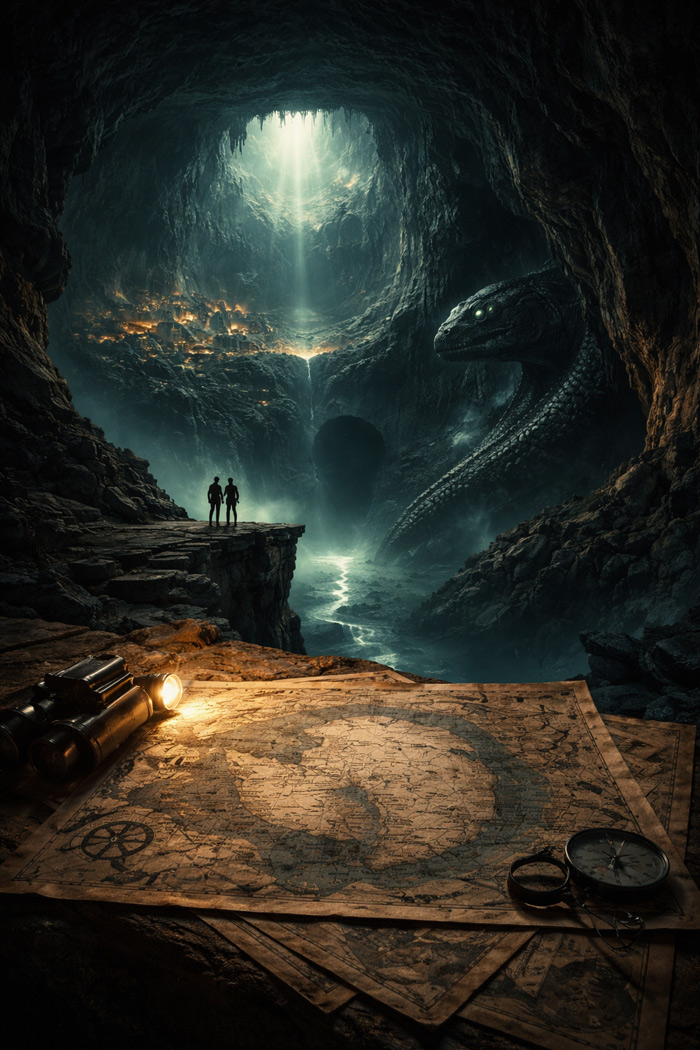
The narrative takes another turn when attention shifts to alleged maps connected to the Third Reich. These maps are said to depict more than territorial ambition. Instead, they illustrate routes, passages, and regions that do not appear on conventional representations of the Earth.
In these accounts, Antarctica becomes a focal point. A real historical expedition to the region is reinterpreted as something more than exploration, suggesting that beneath the ice, openings were discovered—entrances leading into subterranean environments. From there, the story extends into claims of underwater navigation, hidden pathways, and journeys into regions described as internal worlds.
These maps are often characterized not only by what they show, but by what they designate. Certain areas are marked as forbidden, implying boundaries that are not defined by geography alone, but by something unknown or intentionally concealed.
The idea that such routes could exist beneath polar regions introduces the possibility that the Earth’s surface is only a fraction of its total structure. Within this interpretation, exploration did not end at the edge of continents, but continued into depths that remain inaccessible to the public.
A Hidden Continuity
When these elements are viewed together, a broader picture begins to emerge. Underground entities, ancient inner worlds, and hidden maps are no longer separate ideas, but interconnected pieces of a single narrative. Each reinforces the others, suggesting a continuity of knowledge that has been discovered, concealed, and possibly preserved across generations.
In this framework, powerful institutions are not merely guarding technological secrets, but managing awareness itself. Information is compartmentalized, access is restricted, and the true scale of what lies beneath is kept out of public view.
The implications of such a reality are difficult to measure. If even a fraction of these claims were true, it would challenge the fundamental understanding of human history, geography, and existence. It would suggest that humanity is neither alone nor fully aware of its environment.
The Firmament and the Origin of Non-Human Beings
Another layer of this narrative challenges one of the most widely accepted assumptions about non-human life—the idea that it originates from distant planets or galaxies. Instead, some interpretations draw from ancient texts, particularly the Book of Enoch, to suggest a very different framework for understanding their existence.
In these writings, the structure of the world is described as enclosed by a firmament, a boundary created to separate realms and maintain order within creation. Rather than depicting an infinite, open cosmos as it is commonly understood today, this perspective presents a contained system—one in which different domains exist in proximity, yet remain largely inaccessible to one another.
Within this context, non-human beings are not necessarily visitors from outer space, but inhabitants of adjacent realms within the same overall structure. Their presence on Earth, therefore, would not represent interstellar travel, but movement between layers of a shared environment that humanity does not fully perceive.
The Book of Enoch speaks in detail about beings that descended to Earth, interacting with humanity in ways that blurred the line between the physical and the divine. These accounts describe entities with advanced knowledge, long lifespans, and motivations that do not align with human interests. For those who interpret these writings literally, they offer a framework in which non-human intelligence has always been part of Earth’s story.
This perspective shifts the question entirely. Instead of asking where these beings came from, it suggests asking why their existence has been separated from common understanding. If the world is structured in layers, divided by boundaries that are both physical and perceptual, then what is considered hidden may not be distant at all—only obscured.
In this interpretation, the underground realms, the inner world, and the presence of non-human species are not isolated mysteries, but interconnected elements of a larger design. A design in which humanity occupies only one visible layer, while others exist just beyond reach, separated not by distance, but by the limits of perception.
The implication is subtle but profound. The unknown may not lie in distant stars, but within the structure of the world itself—closer than imagined, yet hidden by the very framework that sustains it.
The Great Galactic War and Its Legacy
This is where the story starts to become far fetched, so brace yourselves: The conflict between these groups stems from the Great Galactic War, initiated when the Draconians destroyed three planets in the Lyran system (Bila, Teka, and Merck) after a misunderstanding. The peaceful, agricultural human colonies there were seen as a resource to be controlled. This attack, which killed over 50 million humans, is a foundational event in the ongoing struggle. The Draconians view humans as invaders responsible for their suffering, a belief system they instill in their own kind, while the Andromedans support the surviving human descendants.
Draconian Biology and Society
The Alpha Draconians are described as the oldest reptilian race, originating from another universe. The royal line, known as the Ciakar, are massive, ranging from 14 to 22 feet tall, with winged appendages. Their society is brutal; offspring are abandoned at birth and raised by a warrior class for combat. This "survival of the fittest" culture has led to a Service-to-Self philosophy, where they see less advanced beings as natural resources, both for labor and consumption. They are said to enjoy human flesh, particularly that of children, due to the perceived purity and intense energy produced when a child is in fear.
Andromedan Perspective on Humanity
The Andromedans hold a profound respect for human potential, believing humans possess a unique spiritual and creative power that other races lack. They teach that humans, through their extreme emotions and intent, can literally create reality in "third density" (our physical plane) without technology, a feat the Andromedans themselves cannot achieve. This immense power is why they are deeply concerned about humanity's self-destructive tendencies, such as environmental degradation, which they find incomprehensible.
The Galactic Hierarchy
The Andromedans describe a galactic hierarchy of "regressive" (fear-based) and "progressive" (love-based) civilizations. The Draconians from Alpha Draconis sit at the top of the regressive hierarchy, using genetic manipulation as their primary tool for control. They conquered the Greys 891,000 years ago, slaughtering most of their females and genetically altering the survivors into a slave race. The Andromedans, in contrast, are part of the progressive forces who oppose this control and advocate for free will and spiritual evolution.
The Question That Remains
There is no publicly acknowledged and confirmed evidence supporting the existence of subterranean civilizations, non-human predators, or hidden internal worlds connected by ancient routes, but there are signs that most of this could somehow be true… with the persistence of these stories, and the way they intersect across different sources and time periods, they continue to attract eyes and spark curiosity.
Whether interpreted as myth, metaphor, or suppressed reality, the narrative points to a single, enduring question.
What if the greatest unknown is not above us, but below—and what if it has been there all along?