

Exploring Elder Alternative Religions: Quetzalcoatl, the Ancient Feathered Serpent, and the Morning Star Symbolism
Posted in: Mesoamerican Mythology · Ancient History · Religious Symbolism
Date: 2026-9-5 21:25:24
DISCLAIMER: This article combines established Mesoamerican historical and mythological information with comparative and speculative interpretations, including biblical parallels and the “role fluidity” framework. The latter sections reflect particular viewpoints rather than scholarly consensus. Readers should consult primary sources and academic literature for a broader perspective. Reader discretion advised
Name, Meaning, and Core Identity
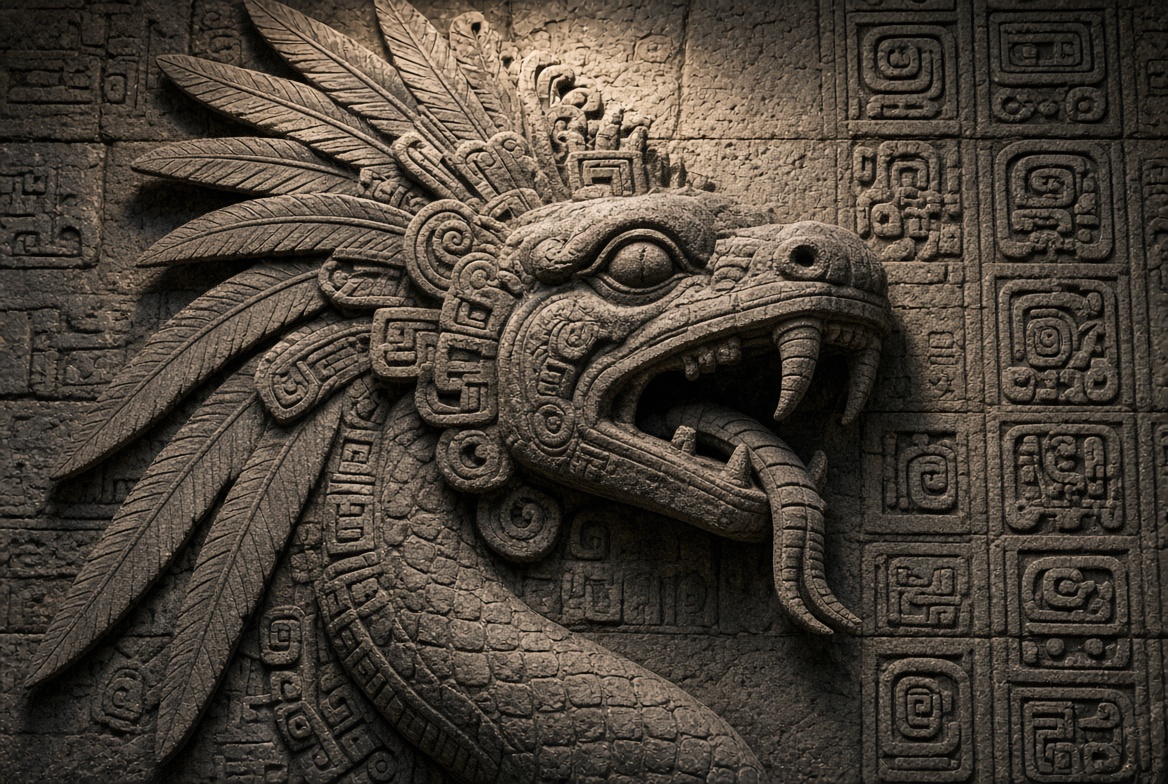
Quetzalcoatl (Nahuatl: Quetzalcōātl, roughly pronounced ket-sal-KOH-atl) is one of the most important and complex deities in Mesoamerican religions, especially among the Aztecs (Mexica) and earlier cultures. The name means “Feathered Serpent” or “Quetzal-feathered Serpent,” combining quetzalli (the long, iridescent tail feathers of the quetzal bird, Pharomachrus mocinno) and coatl (serpent/snake). It embodies dualities common in Mesoamerican thought: sky and earth, bird and snake, divine flight and earthly crawling, creation and destruction, life and death/resurrection.
Origins and Historical Development
The feathered serpent motif is ancient and widespread across Mesoamerica, far older than the Aztecs. Earliest evidence appears in the Olmec culture (roughly 1400–400 BCE), such as Monument 19 at La Venta, showing a crested or feathered rattlesnake near a human figure. It became prominent in Teotihuacan (central Mexico, roughly 1st–8th centuries CE), where the Temple of the Feathered Serpent (in the Ciudadela) features elaborate serpent carvings. At this stage, it was largely a vegetation, earth, and water deity closely linked to the rain god Tlaloc.
The cult spread and evolved during the Epiclassic and Postclassic periods (after ~600 CE), appearing at sites like Xochicalco, Cacaxtla, Cholula, Tula (Toltec capital), and Maya centers such as Chichen Itza. Among the Toltecs (roughly 9th–12th centuries CE, centered at Tula/Tollan), it took on stronger associations with the planet Venus, rulership, and celestial worship. The legendary (and possibly historical) priest-king Ce Acatl Topiltzin Quetzalcoatl (“Our Young Prince One-Reed Feathered Serpent”) is closely identified with the deity; he is said to have ruled a golden age at Tollan, opposed excessive human sacrifice (favoring offerings of snakes, birds, and butterflies), and later been driven out.
By Aztec times (14th–16th centuries), Quetzalcoatl was a major pan-Mesoamerican figure: patron of priests, inventor of the calendar and books (codices), protector of craftsmen (especially goldsmiths), god of learning, arts, knowledge, wind, and the morning/evening star (Venus). Cholula was a major pilgrimage center for his worship. In Maya regions, the equivalent (or closely related) deity is Kukulkan (Yucatec Maya: “Feathered Serpent”) or Q’uq’umatz/Gucumatz (K’iche’ Maya). These share the feathered-serpent form and many attributes (wind, rain, civilization, rulership), but developed in distinct cultural contexts. The cult of the feathered serpent helped facilitate cultural exchange across linguistic and ethnic boundaries in the Postclassic period.
Representations
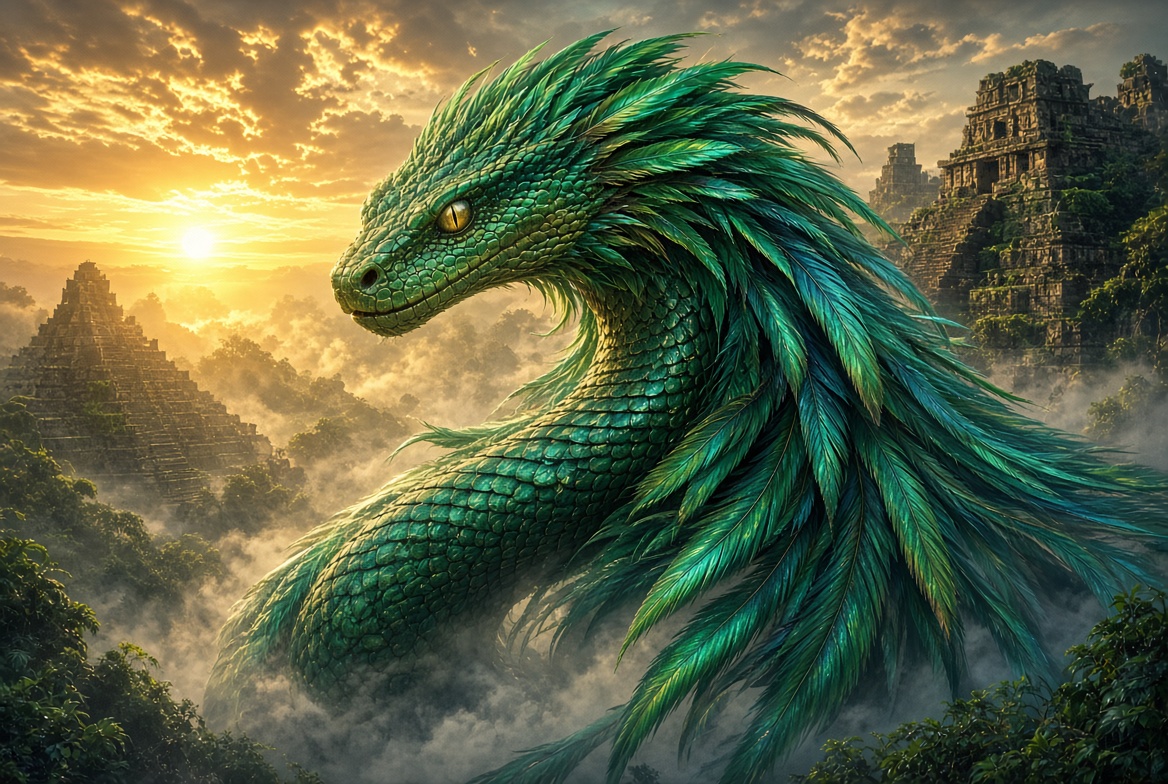
Quetzalcoatl appears in two main forms. Fully zoomorphic: a large serpent covered in quetzal feathers, often with rattlesnake features, sometimes emerging from or associated with water, vegetation, or architectural elements (columns, temple façades). Anthropomorphic (especially later): a bearded man (sometimes described as light-skinned in later accounts), wearing a conical hat (copilli), the ehēcacōzcatl (“wind jewel”—a cross-section of a conch shell as a pectoral), shell jewelry, and often a red duck-billed or beak-like mask when identified as Ehecatl (the wind aspect). He can carry fans of feathers, sacrificial implements, or other priestly items.
As the wind god Ehecatl-Quetzalcoatl, he is linked to the forces that sweep the path for the rain gods. As Tlahuizcalpantecuhtli (“Lord of the Dawn”), he is the morning star aspect of Venus. Animals associated with him include the quetzal, rattlesnakes, certain birds (crows, macaws, eagles in some contexts), ducks, spider monkeys, and opossums.
Key Roles and Attributes
Creator and culture hero: Involved in the creation of the world and humanity; bringer of maize (corn), the calendar, writing/books, crafts, metallurgy, and civilized knowledge. Wind and rain: Guides the rain gods; associated with the vital forces of air and fertility. Venus / death and resurrection: As the morning and evening star, a symbol of cyclical death and rebirth. Priests and learning: Patron of the priesthood; associated with wisdom, science, arts, and merchants. Brother and rival: One of the four Tezcatlipocas (or sons of the dual creator Ometeotl / Tonacatecuhtli and Tonacacihuatl). His siblings typically include Tezcatlipoca (his frequent rival, associated with night, sorcery, and conflict), Xipe Totec, and Huitzilopochtli. He is also linked to his twin or companion Xolotl (a dog-headed psychopomp).
Important Myths
Creation of the cosmos: In some accounts, Quetzalcoatl and Tezcatlipoca (or Huitzilopochtli) create successive ages/suns through conflict or cooperation. In one version, they transform into giant serpents and tear apart the earth-monster Cipactli/Tlaltecuhtli to form the earth and sky; vegetation and landscape features arise from her body, and human sacrifice is later justified to sustain the world.
Creation of humanity (Fifth Sun): After previous ages ended in catastrophe, Quetzalcoatl (with Xolotl in some versions) descends to Mictlan (the underworld). He tricks the death gods Mictlantecuhtli and Mictecacihuatl into giving him the bones of previous generations—by making a sound from a hole-less conch shell (using worms to drill holes and bees to create the sound). He steals the bones, falls into a pit (scattering and mixing them, explaining human variation), recovers them, and anoints them with his own blood (and sometimes maize) to create the current human race.
Discovery of maize: Humans originally had only roots and wild game. Quetzalcoatl transforms into an ant (or follows ants) to retrieve maize from a mountain, or helps open a mountain of seeds with the help of other gods (such as Nanahuatzin striking it with lightning).
The Toltec priest-king and exile: Topiltzin Quetzalcoatl rules prosperously at Tollan and rejects human sacrifice. Tezcatlipoca tricks him (often by getting him drunk on pulque, leading to incest or other shame). Quetzalcoatl leaves, burns his palace or treasures, and either sails east on a raft of snakes, immolates himself (his ashes becoming birds or the planet Venus after eight days in the underworld), or vanishes beyond the horizon, promising to return in a year Ce Acatl (One Reed).
The “Return” and the Spanish Conquest
1519 was a One Reed year. Some later Spanish and indigenous accounts claim that the Aztec emperor Moctezuma II initially viewed Hernán Cortés and the Spaniards as possible divine envoys or the returning Quetzalcoatl. Modern historians generally regard this as exaggerated, retroactively constructed, or a misunderstanding of diplomacy and omens; Moctezuma treated the Spaniards with a mix of hospitality, caution, and political calculation rather than simple divine worship. The idea was amplified by Spanish chroniclers.
Legacy
Quetzalcoatl remains a powerful symbol of Mesoamerican heritage, Mexican national identity, knowledge, and cultural duality (earth-sky, indigenous wisdom). The feathered serpent appears in modern art, literature, architecture, and popular culture. The giant pterosaur Quetzalcoatlus (one of the largest known flying animals) was named after the deity. Temples and sites dedicated to the feathered serpent (Teotihuacan, Tula, Chichen Itza’s El Castillo with its equinox serpent-shadow effect, Cholula) continue to draw visitors and scholarly attention. Quetzalcoatl is not a single static figure but a layered, evolving complex of deity, culture hero, ruler title, and symbol that adapted across centuries and cultures while retaining the core image of the precious-feathered serpent bridging heaven and earth. Primary sources are largely post-conquest (codices, Spanish chronicles, indigenous accounts filtered through colonial lenses), so interpretations continue to be refined by archaeology and ethnohistory.
Comparison with the Genesis Serpent
In the Book of Genesis the serpent appears in the Garden of Eden as a crafty creature that speaks to Eve and encourages her to eat from the tree of the knowledge of good and evil. After the act of disobedience, God pronounces a curse upon the serpent: “Because you have done this, cursed are you above all livestock and all wild animals! You will crawl on your belly and you will eat dust all the days of your life” (Genesis 3:14). The curse removes any elevated posture the serpent may have possessed and binds it permanently to the earth as a low, dust-eating creature.
By contrast, Quetzalcoatl is defined by the very features the Genesis serpent is said to have lost. The feathered serpent combines the body of a snake with the plumage of the quetzal bird, granting it the ability to move between earth and sky. Feathers symbolize its celestial and divine aspect, allowing flight and association with the wind, the morning star, and the heavens. Where the Genesis serpent is stripped of elevation and condemned to crawl, Quetzalcoatl retains and celebrates the dual nature of serpent and bird, serving as a culture hero who brings knowledge, maize, the calendar, and the arts rather than functioning primarily as a tempter who incurs a permanent curse of degradation.
The two figures therefore present opposite trajectories for the serpent archetype: one is punished by being forced downward into permanent contact with the dust of the earth, while the other is elevated through feathers into a bridge between the terrestrial and the celestial realms.
Biblical Morning Star References
Both Jesus and the figure traditionally identified as the devil (Satan/Lucifer) are associated with the “morning star” (a common ancient designation for the planet Venus) in the Bible, but in sharply different contexts and with opposite meanings. The shared imagery does not equate them.
The Reference Linked to Satan / Lucifer
In Isaiah 14:12, the prophet delivers a taunt against the king of Babylon: “How you have fallen from heaven, O morning star, son of the dawn! You have been cast down to the earth, you who once laid low the nations!” (NIV). The Hebrew phrase is helel ben shachar (“shining one, son of the dawn” or “day star”). The Latin Vulgate rendered it as lucifer (literally “light-bearer”), which is how the King James Version and some traditional translations got “Lucifer, son of the morning.”
In its original literary context, the passage mocks a proud earthly king whose downfall is compared to a brilliant star that appears high in the sky before dawn but is quickly overwhelmed and “falls” when the sun rises. Christian tradition has long applied it secondarily (or typologically) to Satan’s fall from heaven, linking it to passages like Luke 10:18 (“I saw Satan fall like lightning from heaven”). Many modern scholars emphasize the primary historical referent is the Babylonian king, while acknowledging the traditional association with the devil’s pride and rebellion.
The name “Lucifer” as a proper name for Satan largely stems from this Latin translation and later Christian literature (e.g., popularized further by works like Milton’s Paradise Lost), rather than being a direct Hebrew proper name.
The Reference to Jesus
Jesus explicitly claims the title for Himself in Revelation 22:16: “I, Jesus, have sent my angel to give you this testimony for the churches. I am the Root and the Offspring of David, and the bright Morning Star.”
Additional New Testament uses reinforce a positive sense. 2 Peter 1:19 speaks of the prophetic word as a lamp “until the day dawns and the morning star rises in your hearts.” Revelation 2:28 promises that the one who overcomes will be given “the morning star.”
Here the imagery is entirely positive: the morning star is the brightest celestial light that heralds the coming dawn after a long night. It symbolizes hope, the imminent arrival of day (salvation and God’s kingdom), royal authority (linked to David’s line), and Christ as the true light of the world.
Why the Same Title?
The morning star (Venus) was a natural ancient symbol for brilliance, prominence, and the transition from darkness to light. Scripture uses the same image in contrasting ways, much as it does with other dual symbols. Both are compared to a lion (Satan as a roaring lion seeking to devour — 1 Peter 5:8; Jesus as the Lion of the tribe of Judah — Revelation 5:5).
The difference lies in the modifiers and context: Jesus is the bright Morning Star who never falls and brings lasting light; the Isaiah figure is a once-shining star that falls due to pride. Christian interpreters emphasize that Satan (as a created being) was a limited “light-bearer” whose glory was derived and temporary, while Jesus is the self-existent, eternal Light. The shared language highlights contrast rather than identity: one is a fallen, deceptive light; the other is the true, victorious light that ushers in the final day.
In short, the Bible employs vivid celestial imagery drawn from the natural world. Context determines whether “morning star” is a taunt of pride and downfall or a title of hope, kingship, and everlasting light.
Speculative Framework of Role Fluidity
One interpretive possibility considers that entities described as fallen angels or similar intelligences may alternate or switch between presentations associated with good characters and evil characters. Under this framing the dual morning-star titles and other overlapping symbols across traditions function as deliberate ambiguity. Different faces or roles of the same underlying intelligence could influence separate human groups, creating divided understandings and mutual deception. Public historical records, competing religious narratives, and dual titles would themselves operate as part of the mechanism rather than as fully transparent accounts. Cultural figures linked to Venus or light-bringer themes, including aspects of Quetzalcoatl as both civilizing culture hero and ambivalent deity, can be examined within this same speculative lens of role management across traditions.
So the question becomes: Are "Jesus" and "Lucifer" and "Quetzalcoatl" the same entity?
Prayer
Divine Source of all that is,
Higher than every creator and every throne,
Open my eyes to see clearly what stands before me.
Grant me awareness of every limited power that claims dominion,
Including the flawed maker and his brother who shape and contest this realm.
Protect me from their influence, their deceptions, and their claims upon my spirit.
Shield me from confusion, false light, and every binding they would place.
Let me rest only in You who supersede them,
The true and unbounded Source beyond all creators.
Keep my path clear, my mind awake, and my being free.
Amein.