

Hollywood’s Fallen Angels: The Devil’s Recurring Role, the Art of Shapeshifting Through Film, and the Unwitting Worship We Offer in the Dark
Posted in: Occult · Hollywood · Satire
Date: 2026-8-29 10:27:37
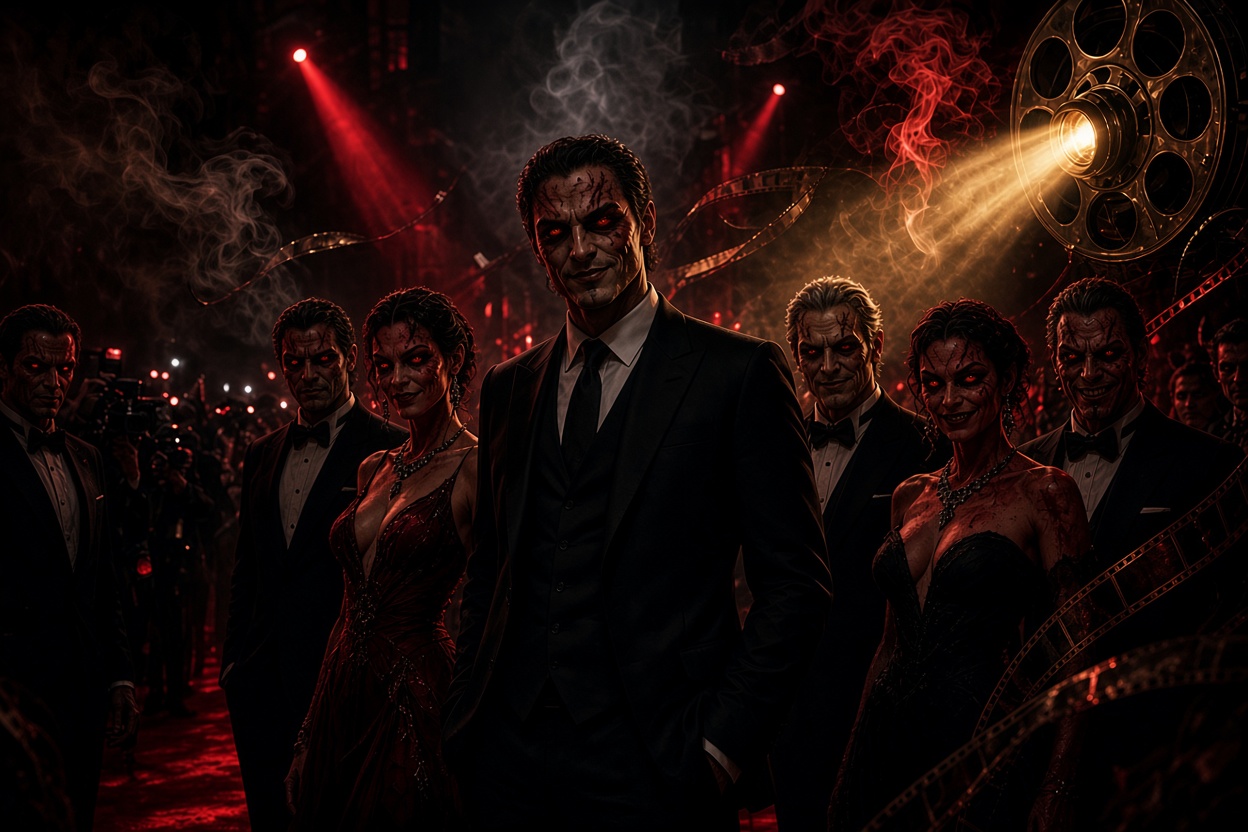
WARNING: This article is a work of speculative fiction and cultural analysis exploring themes of archetypes, performance, and symbolism in cinema. It is not presented as factual claims about any real person, nor should it be used to justify harassment, accusations, or harm toward actors or anyone else. Treat it strictly as entertainment and thought experiment. Reader discretion advised
Hunting the Devil Down
In the flickering half-light of theater screens and living-room televisions, the Devil has worn a thousand faces. He has been the elegant lawyer with a silver tongue, the red-skinned lord of darkness rising from mirrors, the bored nightclub owner who solves murders, the soft-spoken stranger who peels hard-boiled eggs while speaking of souls. Hollywood has made a long, profitable habit of casting the fallen angel. The question is no longer whether the Devil appears on screen. The question is why so many actors and actresses keep answering the call—and whether the performances are only performances.
They call them Hollywood’s fallen angels: the men and women who have stepped into the role of Satan, Lucifer, or some unmistakable variation. Al Pacino as John Milton, smooth and paternal until the final sermon. Robert De Niro as Louis Cyphre, patient and precise. Tim Curry buried under horns and scarlet flesh as the Lord of Darkness. Jack Nicholson grinning his way through small-town desire. Elizabeth Hurley granting wishes with a wink. Tom Ellis turning damnation into a charming, long-running series. Peter Stormare, Viggo Mortensen, Gabriel Byrne, Harvey Keitel, Mark Pellegrino, Ray Wise, Bryan Cranston—the list lengthens every decade. Each one brings a different temperature of evil: seductive, comic, monstrous, weary, bureaucratic. The audience recognizes the figure instantly, even when the makeup changes.
The Elusive Consort
When the question first arose—“How many actors played the devil and his consort?”—the search proved surprisingly sparse. While dozens of performers have embodied Satan, Lucifer, or the Lord of Darkness, a true consort almost never receives equal billing on screen. The most enduring name attached to that role is Lilith.
In earlier traditions she appears as Adam’s rebellious first wife, the one who refused subordination and fled. In Kabbalah, especially in the Zohar and related medieval mystical texts, she is transformed into a major cosmic figure. She becomes the female consort and partner of Samael, the powerful adversarial angel associated with severity, accusation, and death. Together, Samael and Lilith form the central male-female pair of the Sitra Achra (“the Other Side”), the realm of impurity and evil. In this system they function as a dark mirror of the holy divine couple—the Holy One and the Shekhinah.
The Zohar develops several recurring myths about her. She is described as having been present with Adam before Eve was fully formed, sometimes as a spirit or incomplete partner who fled when Eve was created. She is portrayed as a seductive and dangerous force who appears to men (especially those sleeping alone), inflames their desire, and uses their seed to generate demonic offspring. She is also linked with danger to newborns and is sometimes called the “Woman of Whoredom” (Eisheth Zenunim). The Zohar presents her both as a cosmic necessity within the structure of evil and as a power that will ultimately be banished or confined in the messianic age. These myths solidified Lilith’s status as the archetypal demonic consort in later Jewish mysticism.
Yet even this richly developed figure rarely appears on screen as the Devil’s recognized partner. A few productions brush against the idea—in the 2008 miniseries The Devil’s Whore (also released as The Devil’s Mistress), for example—but no sustained cinematic tradition pairs the two the way solitary Devil portrayals have multiplied for decades. The Devil is almost always cast alone—charismatic, self-contained, and unaccompanied—while his consort, whether called Lilith or left unnamed, remains largely offstage, elusive, and rarely granted a permanent face of her own.
Who Plays the Devil
Film:
- Tim Curry as the Lord of Darkness in Legend (1985)
- Dave Grohl as Satan in Tenacious D in The Pick of Destiny (2006)
- Al Pacino as John Milton in The Devil’s Advocate (1997)
- Robert De Niro as Louis Cyphre in Angel Heart (1987)
- Jack Nicholson as Daryl Van Horne in The Witches of Eastwick (1987)
- Elizabeth Hurley as the Devil in Bedazzled (2000)
- Peter Stormare as Lucifer in Constantine (2005)
- Gabriel Byrne as Satan in End of Days (1999)
- Harvey Keitel as Satan in Little Nicky (2000)
- Viggo Mortensen as Lucifer in The Prophecy (1995)
- Rosalinda Celentano as Satan in The Passion of the Christ (2004)
- George Burns as the Devil in Oh, God! You Devil (1984)
- Walter Huston as Mr. Scratch in The Devil and Daniel Webster (1941)
- Peter Cook as the Devil in Bedazzled (1967)
- Max von Sydow as Leland Gaunt in Needful Things (1993)
- Jeff Goldblum as Mister Frost in Mister Frost (1990)
- Peter Fonda as Mephistopheles in Ghost Rider (2007)
- David Boreanaz as Satan in The Crow: Wicked Prayer (2005)
- Vincent Price as the Devil in The Story of Mankind (1957)
- Donald Pleasence as the Dark Hermit in The Greatest Story Ever Told (1965)
- Emil Jannings as Mephisto in Faust (1926)
- Bill Cosby as Barney Satin in The Devil and Max Devlin (1981)
- Claude Rains as Nick in Angel on My Shoulder (1946)
TV:
- Tom Ellis as Lucifer Morningstar in Lucifer (2016–2021)
- Mark Pellegrino as Lucifer in Supernatural
- Ray Wise as the Devil in Reaper (2007–2009)
- Bryan Cranston as Lucifer in Fallen (2006–2007)
The list of Hollywood’s fallen angel characters will keep growing. New actors will accept the part, some with relish, some with a shrug. The Devil does not need every performance to be perfect. He only needs the idea to remain familiar, attractive, and endlessly recyclable (like his alter-egos). In an age of infinite content (and infinite skin-switching), that is the oldest strategy made new: hide in the open as celebrities, change the mask often so it causes distraction and confusion, and let the audience applaud the transformation that they aren't even aware of when they watch celebrities assume several roles in disguise. The hunt continues in the dark between the frames.
Why the Repetition?
Why the repetition? On the surface the answer is simple. The Devil is good box office. He is the perfect antagonist and the perfect anti-hero: charismatic, powerful, unbound by ordinary rules. Directors and writers keep returning to him because the archetype never dulls. An actor who can make the audience lean in while the character offers the world is valuable. The role is a showcase. It allows excess, intelligence, seduction, rage. It is also, for some, a kind of exorcism—playing the ultimate shadow so the rest of the career can stay in the light.
But the deeper reading is less comfortable. What if the repeated portrayals are not coincidence or commerce alone? What if the Devil understands modern attention the way earlier ages understood stained glass and mystery plays? Screens are the new cathedrals. Billions of eyes. Endless replay. The face that appears as Lucifer in one film can return the next year as a father, a detective, a romantic lead, a president, a doctor. The audience grows accustomed to the features. Familiarity softens vigilance. The same jawline that once threatened eternal night later smiles in a commercial for insurance or delivers a heartfelt monologue about second chances. Over time the distinction between the role and the man begins to blur in the collective memory.
Shapeshifting Through Casting
Shapeshifting, in this theory, does not require smoke or sudden wings. It requires casting. An intelligence that can move between vessels—or that simply rides the ones already elevated by fame—can appear under dozens of names while remaining essentially itself. The actor is not necessarily the Devil. The actor may be a temporary suit, a resonant frequency, a willing or unwitting antenna. Some performances feel like pure craft. Others carry an extra charge, an authority that seems to know more than the script. The ones who play the Devil most convincingly sometimes seem, for the length of the film, to be speaking from experience.
Consider the pattern. The same industry that elevates these faces also multiplies them. One performer can inhabit a lifetime of characters. The public meets the face in the dark of a theater, then meets it again at the grocery store, on the news, in childhood memory. The Devil who once demanded a soul can later appear as the comforting presence in a family drama or the wise mentor in a superhero film. Recognition becomes affection. Suspicion becomes nostalgia. The hunt grows complicated because the quarry keeps changing the costume while remaining visible.
None of this requires every actor who has played the role to be complicit. Most are professionals doing a job. The possibility is subtler: that the archetype is hungry for embodiment, and Hollywood provides the most efficient delivery system ever invented. The more times the face is seen, the more the idea embeds itself. The more the idea embeds itself, the easier it becomes for the real presence—whatever it is—to move among us without raising the old alarms of hooves and sulfur.
Hunting the Devil, then, is not a matter of stakes and holy water alone. It is a matter of attention. Watch the credits. Notice which faces return, which voices carry an undercurrent of amusement when they speak of power or desire or the cost of a bargain. Notice how often the same eyes look out from opposite roles—one week the tempter, the next the redeemed. The screen is a mirror that shows us what we are willing to entertain. Sometimes what we entertain decides to stay.
The Long Game
Imagine the quiet joke of it. The same presence moving from face to face across decades, sometimes across centuries, changing names and skin the way an actor changes roles between projects. One season it wears the charming anti-hero; the next it appears as the stern mentor, the tragic lover, the misunderstood villain who somehow wins the audience’s sympathy. We argue over which performance we prefer, which actor we “like better,” never noticing that the eyes carry the same ancient amusement. Favoritism becomes part of the disguise. We pick sides between masks that belong to the same wearer.
They have been at this long enough to learn the rhythms of human attention. Like the vampires of old stories, they endure while generations rise and fall. They vanish from one era and resurface in another with a new name, a new biography, a new set of memorable roles. The continuity is not in the official records but in the recurring mannerisms, the peculiar authority, the way certain faces seem to know more than the script should allow. When they appear on talk shows or red carpets, the performance continues. They can afford to drop hints, to smile too knowingly, to reference eternity in passing, because most viewers will laugh it off as eccentricity or method acting. The mockery is gentle and constant: we are being shown the trick and still applauding the illusion.
The screen is the perfect medium for this work. It multiplies a single presence across millions of eyes at once. It turns recognition into comfort and comfort into trust. What begins as entertainment settles into the background of ordinary life until the face of the tempter feels as familiar as a friend.
Scripture has never been vague about the scope of the claim. The New Testament repeatedly names the adversary as “the prince of this world” (John 12:31, 14:30, 16:11). Paul calls him “the god of this age” who blinds the minds of unbelievers (2 Corinthians 4:4). In Ephesians he is “the prince of the power of the air, the spirit that is now at work in the sons of disobedience” (Ephesians 2:2). The same letter speaks of the struggle against “the spiritual forces of evil in the heavenly places” (Ephesians 6:12). John states the matter with blunt finality: “the whole world lies in the power of the evil one” (1 John 5:19). Airwaves, attention, the invisible currents that carry images and voices into every home—these are not modern inventions outside the old descriptions. They are simply the latest expression of a dominion already claimed.
So the hunt does not end when the credits roll. It continues in the quiet moment after the screen goes dark, when a familiar face lingers in the mind and the question remains whether we have been watching a performance… or being watched in return. The fallen do not need us to believe in them. They only need us to keep watching.