

Understanding the Fallen Angel Azazel: The Corrupting Teacher, the Scapegoat, and the Warning We Ignore at Our Very Own Peril
Posted in: Religion · Mythology · Theology
Date: 2026-8-28 03:29:20
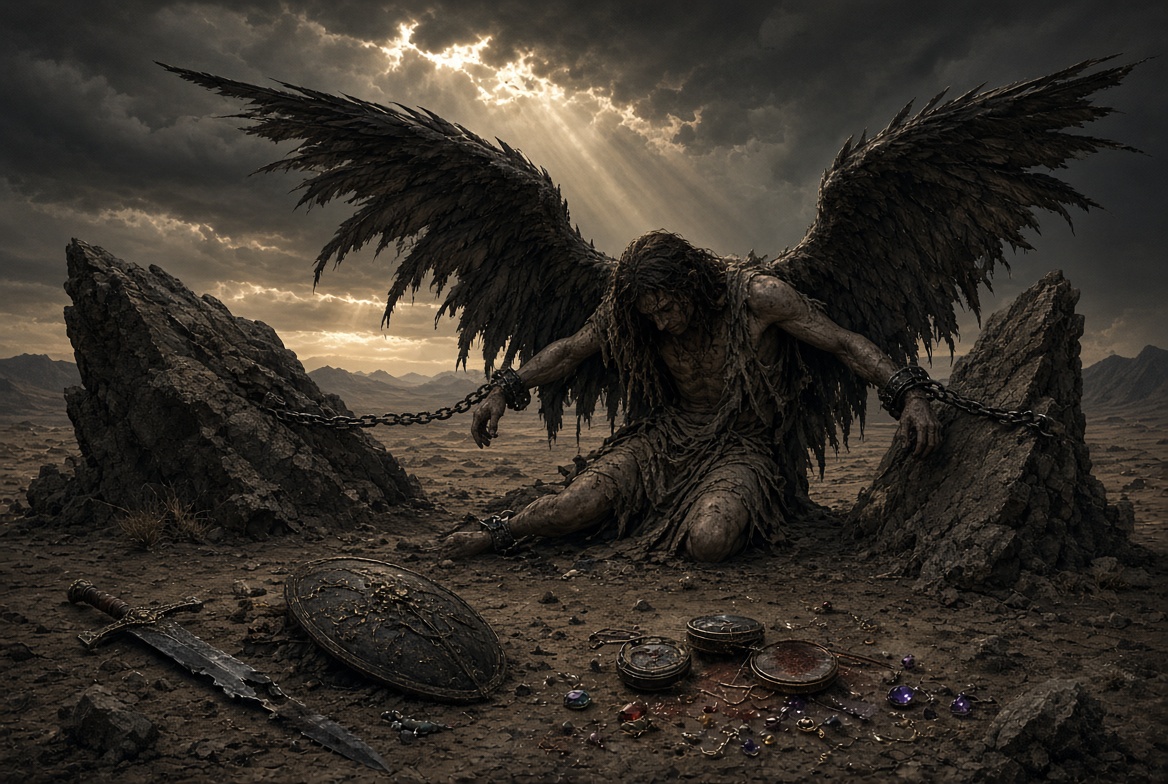
WARNING: Themes of demonic/fallen-angel mythology, sin, corruption, violence (weapons and bloodshed in ancient texts), and final judgment. Reader discretion advised
Who is Azazel
The name Azazel echoes across ancient texts as a figure of exile, forbidden knowledge, and the transfer of guilt. While the Hebrew Bible leaves the term ambiguous, later traditions fill it with a vivid and cautionary story. Azazel becomes the archetypal teacher of corruption—the one who arms humanity with tools of violence and vanity, then bears the blame for the resulting decay. To understand him is to confront an old human pattern: the allure of secret power, the externalization of sin, and the high cost of refusing accountability.
Origins in the Scapegoat Ritual
The name first appears in Leviticus 16, in the instructions for the Day of Atonement (Yom Kippur). Two goats are chosen. One is sacrificed to the Lord. The other—the scapegoat—has the sins of the people confessed over it and is then sent away “for Azazel” into the wilderness. The Hebrew text does not explain who or what Azazel is. Later interpreters treated the word as a place (a rugged cliff or desolate region), a desert demon, or a personal name for an evil power. Medieval rabbi Nahmanides explicitly linked Azazel with Samael, the angel of death and accuser in Jewish tradition. The ritual itself is clear: collective guilt is loaded onto a living creature and driven far away so the community can be cleansed.
This act of removal becomes the seed of a larger myth. The wilderness destination of the goat is later read as the place of the fallen being’s own confinement.
The Book of Enoch: Azazel as Leader and Corrupter
The most detailed portrait of Azazel comes from the Book of Enoch (1 Enoch), an ancient Jewish apocalyptic work that was influential in Second Temple Judaism and early Christianity though not part of the canonical Hebrew Bible or most Christian canons. Here Azazel is no mere place-name. He is a leader among the Watchers—200 angels who descend to Mount Hermon, lust after human women, and father the giant Nephilim.
Azazel’s distinctive crime is teaching. He instructs men in the forging of swords, knives, shields, and breastplates, and in the working of metals. To women he reveals cosmetics, the dyeing of hair, face paint, antimony, and the use of precious stones. He discloses “the eternal secrets which were in heaven.” The result, according to the text, is widespread corruption. 1 Enoch 10:8 declares: “The whole earth has been corrupted through the works that were taught by Azazel: to him ascribe all sin.”
God responds with judgment. The archangel Raphael is commanded to bind Azazel hand and foot and cast him into the darkness of the desert of Dudael. There he remains until the final judgment, when he will be thrown into the fire. This binding in the wilderness is widely understood as a mythic expansion of the Leviticus scapegoat rite: the goat sent to Azazel reenacts the fallen angel’s own exile and the removal of the corruption he introduced.
Other Ancient Witnesses
Fragments among the Dead Sea Scrolls (including material related to the Book of Giants) present Azazel as a leader of the Watchers alongside Samyaza (Shemihazah), again associated with warfare and deception.
In 3 Enoch (a later Merkabah text), the story shifts. Azazel, together with Azza/Shemhazai and Uzza, objects to the elevation of the human Enoch into the angelic figure Metatron. For this they are cast out of heaven; they are also described as having once served as guardian angels of Egypt.
The Apocalypse of Abraham offers a more monstrous depiction: Azazel appears as a bird-like being with six pairs of wings, seven heads, and fourteen faces. Some scholars see in this text an equation of Azazel with Satan himself.
Islamic Tradition
In Islamic sources the closely related name Azazil appears as a pre-fall designation for Iblis. Azazil is portrayed as a noble angel (or a jinn raised to high rank) who refuses to bow to Adam, arguing that a being of fire should not prostrate before a being of clay. For this act of pride he is cast down and becomes Iblis, the adversary. Some Muslim scholars connect the name to the Hebrew tradition; others propose an independent Arabic root related to removal or separation. While the refusal-to-bow motif differs from the Enochic emphasis on forbidden arts, the shared theme of rebellion and expulsion is clear.
Distinctions That Matter
Azazel is frequently confused in popular culture with other figures:
- Samael: the angel of death, accuser, and tempter in Jewish demonology.
- Iblis / Azazil: the Islamic adversary who refuses to bow to Adam.
- Azrael: the angel of death who acts under divine command and is not portrayed as evil.
- Lucifer / Beelzebub: associated with pride or the “lord of the flies.”
Azazel’s core identity remains that of the corrupting teacher and the recipient of the scapegoat. He is not primarily the prideful rebel of the Christian Lucifer tradition, nor the death-angel of other lore.
The Symbolic Weight and the Price of Ignoring the Warning
Azazel functions as the archetypal scapegoat: the being onto whom collective guilt is loaded and who is then banished to the wilderness. The story encodes a persistent human impulse—to externalize sin, send it somewhere distant, and imagine a dramatic moment of removal. Yet the Enochic narrative refuses to leave the matter there. Corruption is not merely projected outward; it is taught, practiced, and internalized. Weapons, cosmetics, and “eternal secrets” do not stay with the teacher. They reshape society, produce violence and vanity, and invite judgment.
The texts present a stark choice. Awareness of the source and nature of the corruption is required. The Watchers’ gifts look like empowerment—metal for defense and beauty for adornment—yet they become instruments of bloodshed and deception. When the earth is filled with the consequences, the teacher is bound and the people still face reckoning. The ultimate price, in the apocalyptic framework, is fire on the Day of Judgment for the unrepentant teacher and the lasting damage already wrought among those who received and used the forbidden arts.
Whether one reads these accounts as history, myth, moral allegory, or a mixture, the pattern remains instructive. Forbidden knowledge that promises mastery often delivers dependence and decay. The ritual of the scapegoat offers temporary relief by sending guilt away; the fuller story insists that the corruption itself must be recognized and refused. To remain unaware—or to embrace the gifts while denying their source—is to invite the same exile and the same fire.
Azazel’s story, then, is not merely ancient lore. It is a repeated warning: the teacher of corruption still whispers through every technology of violence and every art of vanity that promises power without wisdom. Those who listen without discernment risk repeating the ancient pattern and paying its final cost.
Heavenly Father YHVH,
Almighty Creator of heaven and earth, I come before You in the name of Yahusha, Your Son, seeking refuge under the shadow of Your wings.
Protect me and all who call upon Your Name from the corruption, deception, and influence of Azazel and every fallen spirit that seeks to lead astray.
Bind every work of darkness, silence every lie of forbidden knowledge, and cover us with the blood of Yahusha.
Keep our hearts pure, our minds steadfast, and our steps ordered by Your Word.
Deliver us from evil, and let Your light drive out all darkness.
In the mighty name of Yahusha the Messiah…
I say Amein.